Showing posts with label time. Show all posts

Monday, July 30, 2012

A kind of ending

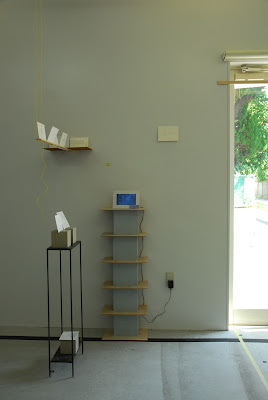
Here are some views of 'Living Everyday by Art' after its 7-weeks progress.


Saturday, July 28, 2012

Another layer for another Dimention


On the second last day of the project, there was a relatively big change in the content. The collaboration between the local silkscreen workshop, CLEAR GRAPHIC, and myself finally came into the shape.
Mr. Matsumura, the director of the workshop, pushed the project further to present the visual dialogue between each artist's works. It was organically developed, found and extracted, and linked poetically by my translation and mediation. This was only possible because of the length of 5 weeks' progress, and the encouragement by Mr. Matsumra.
He kindly shared his skill and interest. He says, "as a printer, I found most interesting when I understand the intention and essence of work, and I can emphasis the concept and let it stay firmly as a print work." Through his network, he printed works by various ways of printing and kinds of papers.
   
(top lef: Gaku, silkscreen print on cut out yellow paper / top right: Thea, digital print of a still image from her video work on paper & silkscreen print on film / bottom left: Elizabeth, laser print on tracing paper /bottom right: Utako, edited b&w image digital printed & colored area silk screened)

Monday, July 23, 2012

Gazes and Voices 3


Sunday afternoon, people came on the bicycle, by car, by bus and by walk. Questions were asked about the project, title, status of exhibition, concept of the project and so on. Different artists, different art viewers interpreted the project in various ways and expressed their feelings and expectations.

Discussions arised mostly in relation to the meaning of the word, 'exhibition' and 'work in progress', and 'studio practice'. It was questions, how to convey the sense of progress in an exhibition format which implies somewhat finalized work of art? Then another thought came into my mind. Has the concept of this particular project actually never end to be 'completed' work of art? The basic idea of accumulating an everyday making and process should be carried over as long as you live your life everyday?

The graphic designer, who was visiting youkobo for another meeting, said that he also tends to keep working on and on. If there is no such thing called 'deadline', he would not stop. Deadline is like an architecture, structure which decide the duration of time you are inside. Maybe an exhibition is a deadline for artists, to structure their times to make and show works. In the case of the project, I think we might have not needed to have an exhibition, as the core concept, 'making works everyday' would not have an end. Or, the exhibition is not about showing finished artwork, but presenting the status of artwork being produced everyday. It is bit like a live performance piece. Audiences witness the moment of artwork being generated.

Akira Mori who did a project early this year at youkobo came in with his collaboration partner. He also makes a work in combination with concept, object and performance. I was thinking maybe the aspect of work-in-progress has a performative element to the whole project. Artworks moves across continents and across days&weeks. Visitors to the project also shift and change the project slightly, as often their observations and feed-backs give a new perspective to the project.

It was great to see Akira enjoying the various art languages in the gallery. Thea's postcard piece which resonates with her video postcard and Gaku's weekly Manga stays on-line to be downloaded. They point out clearly the relationship between physically being there and not. It was also Mori's project's 'All day 23 wards' theme where things happened outside of gallery and gallery became a container for the conceptual drawing and.


Friday, June 15, 2012

Positioning and Height

Friday night.
During the install... basic positioning are decided.
Top image:From right (Thea, Elizabeth, Gaku, Utako)
Bottom Image: Desk for visitors' note and for something... then things on the wall, and PC on the ground as a information section.
I imagine, everyday, the height of the display will go up....towards 'exhibition' period in July. I still question, the expectation and challenge about how to present artwork in the 'gallery' context... gallery? ground, wall, plinth, ceiling ,installation... without eliminating visitors who might be both not and very well familiar with the experience of being in the gallery.


Tuesday, June 5, 2012

Some thoughts triggered by Roman Ondak

I've just come back from a visit to the Deutsche Guggenheim, where there is an an exhibition of Roman Ondak's work. It's been a while since I saw something I enjoyed so much. Immediately I began to think about the connections between his work and our project, and became inspired for the possible forms my own contributions may take.

Here are a few preliminary thoughts:

From what I have seen of Ondak's work, he engages the everyday in both its forms and its processes. However, he inserts slight disruptions in how we perceive something ordinary, by focusing attention on things usually overlooked, or bringing out the absurdities in banal actions and events.

What came to the fore was an interest in the idea of time as something experienced as part of everyday life. Of waiting, of time passing or stopping. Keyhole 2012, was exactly that - a keyhole in the wall through which one could spy the street outside. What you looked out to was a kind of booth on the grassy median strip, which had a large round clock on it. I wondered whether the clock was part of the work, or whether it was incidental.  It connected in my mind the idea of looking with that of time passing. The idea of looking at time passing - something which immediately slows the experience of time down so as to become excruciatingly palpable.

On the other side of the room was Awaiting Enacted, 2003, a series of newspaper clippings with photos of people waiting in queues. In a similar way it highlighted a process by which the passing of time becomes conscious in the drawn out act of waiting and anticipation, and at the same time illustrated the absurdities of these situations. The act of time passing becomes an event through the action of standing in line. Nearby, was End of One Era, 2012, a broken mechanical calendar on a Le Corbusier table, where time had literally stopped and become only abstract figures.

Time is something so integral to our lives. Of course it is always passing, and we think of it superficially, in terms of being late, or waiting for something, of meeting deadlines, of boredom, anticipation, rushing... (It is interesting to think of the experience of time in relation to the spectacular; is it faster, slower, are we more aware of it than in our daily lives?) My question is, how can we actually work with it? Notice it in the course of our days and lives? Time is something Utako and I have spoken about quite a bit in our conversations lately. We thought that, because this project involves people living in different time zones, sending things by various means which each have their own duration, and the fact that the project is taking form as a work in progress developing within a given time frame, this topic is integral. 

What first made me think of our project, however, was the work, Balancing at the Toe of the Boot, 2010. It was shown in two parts, with clichéd postcards stating "we are still alive" (à la Kawara), and fake newspaper clippings with snapshot type images of the artist posing in front of holiday scenes. In a little documentary film about Ondak, screening alongside the exhibition, it is mentioned that his work often has to do with travel. Not just with physical travel, but also travel in your mind. I think this is an important thing to think about for us as well. In our project we will be sending something away, so it is the object that travels physically, but I think this also provides an opportunity for the artist to travel, metaphorically, within their normal everyday.