Saturday, July 21, 2012

Gazes and Voices 2

NOREN is an old style screen in Japan, made out of fabric, to be set outside of shops and businesses. It is a sign of 'we are open'. Elizabeth, when she was visiting Tokyo, found many of them in the neighborhood. a few She noticed a kind of gaze which this screen creates with its slit between sections and its height.

The entrance of youkobo is glass door, however, the surface reflects daylight so it makes it difficult to see inside from outside. Noren is a good tool as it allows the door to be kept open but still keep the inside separate from outside. Welcoming yet differentiating areas simultaneously. Elizabeth print her text piece on Linen at Silk screen workshop and stitched them to be used as Noren.

I had a hesitation to hang Elizabeth artwork outside for several reasons but, Tatsuhiko, co-director of youkobo, taught me the fact that it has to be hang outside, people might think that we are closed! This advice I felt very typical of Tatsuhiko. He always think not from his side but from the other party side. You clarify first what you want to achieve, then consider best way to do so in relation to the other parties who would receive it.

An old couple (my parent) visited and advised on the distance between each section in relation to its length and the nature of gallery. Their suggestion was to open the gab between sections wider so people can or become wanting to see inside to find out what it is. They don't have art background so they speak on behalf of those who are not used to come to gallery. As I was interested in the idea of experience of art is offered as a part of people's everyday life, their advices become precious.

Friday, July 20, 2012

Drawing as a primary media

On Friday, a student from painting department at GEIDAI dropped by. We chat about drawing and installation. There are impression of drawing being a secondary media. But is it really? As Thea and I went drawing department in art college, it felt important to put thoughts together again, the role of drawing, both concept and method, playing in our making installational work. (to be continued...)

Thursday, July 19, 2012

Gazes and Voices 1

The wall dedicated to participations (left) and record of references &correspondences (right). Reading session on the 22nd and 23rd are introduced with pictures and poetry which participants read according to Seishonagon's sub-theme in her pillow book.  
The dialogue with artists started at the end of last Deccember. The idea of Transnation, transculture and translation was strong, then. (the reference magazine HYOUSHOU vol. 05 Art as Negotiation' and projects note etc are on display.


Wednesday, July 18, 2012

Exhibition: Week 1

First night of the show, people at youkobo gathered in the gallery for a while before the dinner.
Youkobo directors, current residency artists at Youkobo, Catalina from Chile, Almut&Christof from Austria, and visiting artists Ross&Meredith from Melbourne.


Monday, July 16, 2012

Almost


Top: whole view
Middle: Elizabeth, Thea
Bottom: Gaku, Utako


Kind support, family and mentor

Before the idea for the project was shaped, I had shared a dialogue with Elizabeth. I was very much struggling, how to balance my life, job and making of art. She wrote, me how she tries to connect those, to reflect them onto each other.

I was very grateful to have my family and the mentor into the space for the work-in-progress. They kindly supported the last stage of building up the projects. It was literally the moment when life, job and art became one, procssed into living everyday.

Sunday, July 15, 2012

Work in Progress: Week 5

Sunday, while the set up was happening right there, drilling, cutting, nailing, a visitor with a nice summer hat walked into. During the work in progress period, It was surprising for me to find how natural for most people to see a work-in-progress. Before I started this project, I was afraid of the project not being not enjoyed or even understood, in thinking people commonly likes the finished and finalised works. But it was likely wrong assumption. It seems that the idea of sharing process, viewing process are very much welcomed, even in a gallery context, (of course, it depends on the direction of a gallery, and the kinds of audiences they have). I just appreciated a opened minded people who live or visit the area where Youkobo is. also to youkobo which give me the apportunity to experiment. and artists who got on the board together.

Saturday, July 14, 2012

Kind support and Serendipity


The local artist, the residency artsit, the visitors joined to cut and make Gaku's work at the participation section next to the entrance. Wide opened glass door might have created easy for people to walk in to find out about the happening. Thank you very much for those who helped and enjoyed. It was nice and hearty to have people showing their kindness, especially this week, youkobo experienced farewell to our dearest dog, KORO chan. Strangely, Gaku sent work with the dog charactor. Such a serendipity!

Wednesday, July 11, 2012

Outside and Inside of Artist

After my office work at youkobo, I print out, cut and construct Gaku's weekly Art Manga. The dialogue with her was recalled.

Gaku was a residency artist more than 10 years ago at Youkobo. She had moved to NY to have her life there. I felt so lucky to met with her early this year at youkobo when she was making her brief return to Japan. Once you are out of a community that you are used to and was welcomed, you become nothing again. You build from Zero. It is wonderful opportunity to re-evaluate your sense of value, what you think as normal. What is great about her is that her will and commitment in art are so strong that they stay clear in herself, and even get stronger when there are many questions.

Her question to the idea of putting an exhibition in a gallery as an 'normal' way to present artworks, led her to invent another way to communicate with the world through her work. She said, 'I want to focus on making works sincerely. That is most important at the moment. I become interested in the project as it focuses on artist's making works for the sake of making art, and it does value the process of making, not the purpose of making, such as towards an exhibition in the gallery. Utako is not galleryist nor curator. She is an artist, and to question about artists running space, such as Youkobo gallery, that  assist artist making, experiment. That makes valuable for me to be part of.

Sunday, July 8, 2012

Walk in. Walk out.


The forth week of open work in progress, a couple walked into the space. She soon got the idea of work in progress. They walked in as if they popped into shop during having a date. Nishiogikubo is indeed a great spot for wondering and going for a walk to find something unique. 
As an artist and staff member of youkobo, I often feel that the location specificity of Youkobo art space can be considered more, in my opinion, by exhibitors and those who are part of the space. The door can be open wider to the potential visitors.
The artists who joined the exhibition this time all makes work in response to their everyday life. That was part of the intentions of the project to test how to make the youkobo art space gallery accessible for those who are in the moment of living their everyday life. 

Friday, July 6, 2012

Layed out in out in out


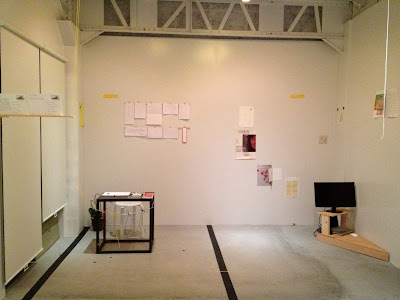
Works in progress from left: Utako, Gaku, Elizabeth, Thea
 
Sections for visitors participation on the left,  information about the dialogue, inspiration and project blog on the right.

Thursday, July 5, 2012

Being Sculptural


Gaku’s work is completed when people download her work from her website, print them out , cut and construct them into a sculptural shape. 
Elizabeth’s text piece is also finalized by becoming an installation and sculptural work. 
Thea's postcard work required both side to be viewed thus it escapes very well from being two dimensional.

I was inspired by the ideas for those two dimensional works to be introduced into spaces. When I install, I tried to find the way to enhance those sensitivities. 
Even my own drawing work, which was drawn vertically on the small desk, is inspired to sit into the space nearly as an object.


Wednesday, July 4, 2012

Work in Progress: Week 4 (wall, extended)

After getting a feedback from a local person on Sunday, I was kept thinking how to develop the project. I saw an exhibition on Monday at the renowned art university in Tokyo. An exhibitor told me that she was advised to think how well she is understanding the characteristic of the space, in relation to her installation piece.
Wednesday, I came back to work.
If there are spaces in the gallery, my bodily space as an installer, and the actually body of work, and physicality of the exhibition space.Images and texts on the works are important and needs to be presented in a proper way.
The question of how to create the relationship between the wall, floor and ceiling, without relying on conventional display methods.
One way of approaching this was to use materials that are pre-existing in the area. I found sticks, strings, ladder and empty bos. It is interesting that some of materials shows the specificity of site. Being in Japan was indicated by Takoito, Japanese thick string very strong, hinoki stick, the kind of wood in Japan which smells wonderful. Or Empty box, no longer used by residency artists, becomes a low table.


Sunday, July 1, 2012

Work in progress: Week 3


This weekend, a few constructive feedback from visitors. A man who lives locally and likes art said to me that 'the installation can present a feeling of on-going growth in a better way. The chemical reaction, derived from 3 artists everyday processes being gathered and displayed in 1 place, must be explored more. I look forward to seeing the every week process, so. ' It was such an inspiring and encouraging comment. It was indeed a question this week for me: so, then, what can happen?


Saturday, June 30, 2012

art in environment: Melbourne and Tokyo


Melbourne (left)
Elizabeth's practicing her Japanese writing in her office at CFI.
The window view from the former Drawing dep. studios.
Thea's work 2009 on outside wall of VCA Studios.
Tokyo (right)
Gallery Info in Japanese: Work in progress is Open to Public.
A street view, outside of Youkobo Studios and Gallery.
Thea's postcards and video-cards are on test display.

One of conceptual aspects of the project, Living Everyday by Art, is to connect everyday working
environments from different sites in the world. It is to propose the idea that whenever you are, artists make things and can put it on display, anywhere is possible really, if you wish for it to be happened. Artist can not only make art but also put it out in the world. Once it is put in the world, it can communicate with others beyond the makers intentions. That is simply wonderful. Attempting creating such an occasion. I am putting the project up in youkobo gallery, everyday, and opening the process every weekend to the public.